

Chicken is one of the most common protein sources around the world. Whether grilled for dinner, shredded into a salad, or simply boiled for a healthy meal, it ticks many boxes: affordable, versatile, and nutritious. But nearly as important as what you eat is how much you eat, and Skinless Chicken Leg Calories, which brings us to calories. Many people zero in on the calories in a chicken leg (skinless) because they’re staying mindful of their diet, aiming to build muscle, or hoping to lose weight. Understanding the calorie count and how it’s affected by cooking and portion size can help you make smarter food choices.
What Is a Chicken Leg?
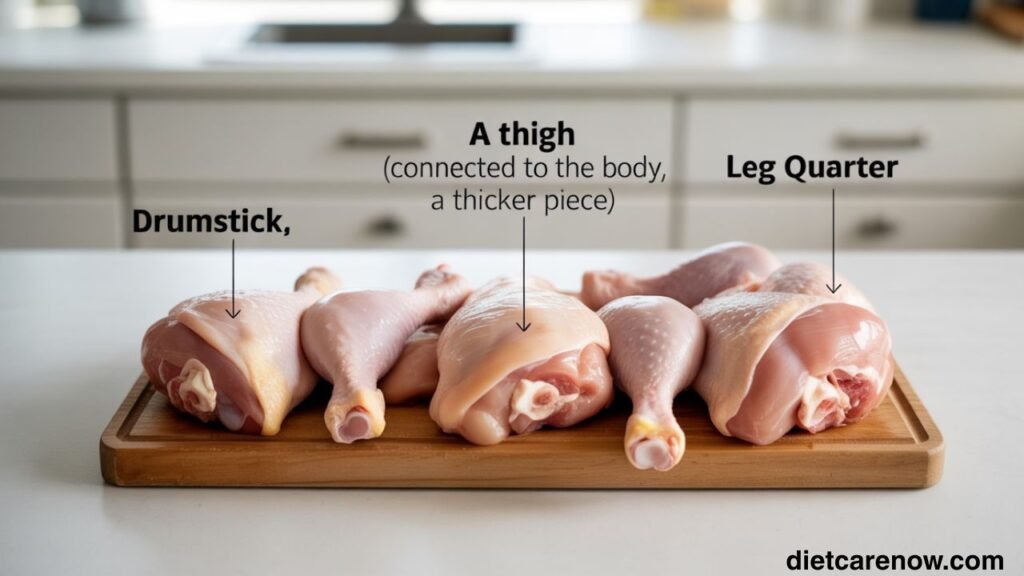
When we talk about a “chicken leg,” we’re referring to the leg of the bird, which is typically composed of two parts: the drumstick (the lower portion) and the thigh (the upper portion). If you buy a “leg quarter,” you’ll often get the thigh + drumstick + a portion of the back or foot sometimes. But when you buy separate pieces, you’ll typically have:
- A thigh (connected to the body, a thicker piece)
- A drumstick (lower leg, narrow end).
Knowing the difference matters because the parts differ in size, meat-to-bone ratio, and fat content—all of which affect calorie counts.
Also read: /grain-power/
Calories in Chicken Leg (Skinless)
Let’s get into the numbers. For a skinless chicken leg (that is, thigh + drumstick, with the skin removed) the calorie counts vary depending on size, whether it’s cooked or raw, how much fat remains, and whether bones are included. Some benchmarks:
- According to one source, 1 ounce (about 28 g) of boneless, cooked, skinless chicken leg meat has approximately 53 calories.
- Another figure: 4 ounces (about 113 g) of boneless, cooked, skinless chicken leg meat ≈ , 212 calories (with about 30 g protein, ~9.4 g fat).
- For raw, boneless, skinless chicken leg, one source lists 318 calories (portion unspecified).
So if you’re eating a moderate-sized cooked skinless chicken leg (say ~100 g meat), you’re likely looking at somewhere around 180–220 calories, depending on exact weight and fat remaining.
Calories in Chicken Drumstick vs. Thigh (Skinless)
Because the thigh and drumstick differ, let’s compare:
- Drumstick (skinless): One cooked, skinless drumstick (96 g) has about 149 calories, with ~23.2 g protein, ~5.5 g fat.
Another data point: 100 g of skinless drumstick (meat only) ~171 calories, ~28 g protein, ~5.6 g fat. - Thigh (skinless): One cooked, skinless thigh (116 g) ~208 calories, ~28.8 g protein, ~9.5 g fat.
Portion size differences and implications:
- Thighs tend to have slightly more fat than drumsticks (when skinless and boneless) and thus more calories per equivalent weight.
- Because the drumstick has more bone relative to meat, if you buy a “whole leg” (thigh + drumstick), the edible meat will be less than the raw weight.
- If you’re tracking calories, it’s helpful to weigh the meat (after cooking, ideally) or use standardised serving sizes.
Raw vs. Cooked Calories in Chicken Leg
Calories change when you cook meat. Why? Because moisture is lost, fat can melt or drip away (or more fat might be introduced), and the weight of the edible portion reduces. For example:
- Raw skinless chicken leg (boneless), one source: 318 calories (portion unspecified).
- Cooked skinless chicken leg: For example, ~100 g cooked skinless chicken leg ~209 calories.
- Another: Roasted, skinless chicken drumstick ~149 calories (for 100 g).
Comparison chart (approximate):
| Condition | Approximate Weight | Calories |
|---|---|---|
| Raw skinless chicken leg | ~100 g | ~200–220 cal (varies) |
| Cooked skinless chicken leg meat | ~100 g | ~180–210 cal |
| Cooked skinless drumstick ~100 g | ~149 cal |
Bear in mind these are approximate and will vary by portion size, cooking method, and how “skinless” and “boneless” the meat is.
Protein, Fat & Carbs Breakdown
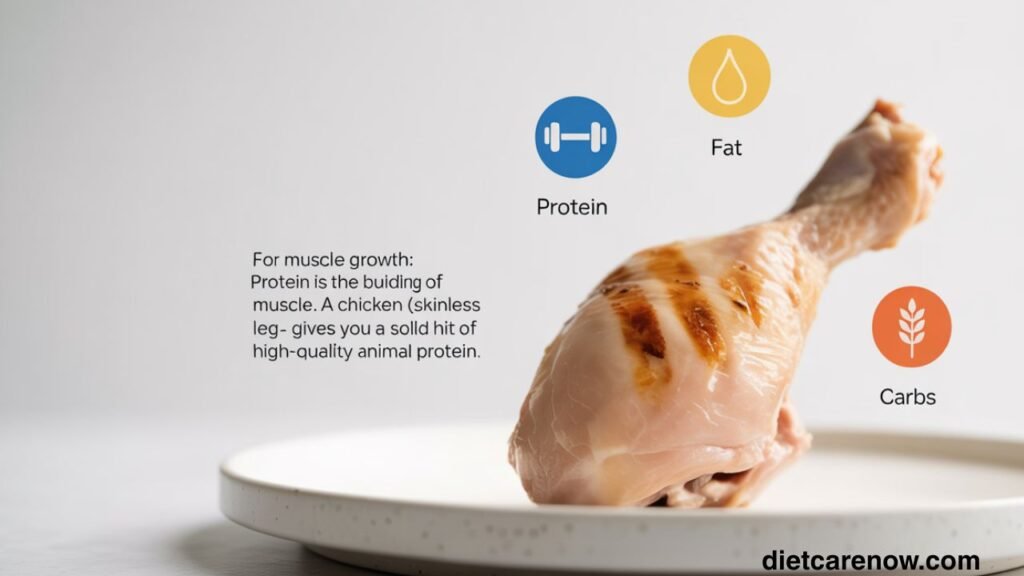
When you’re eating a skinless chicken leg, you’re getting mostly protein and some fat, but very little carbohydrate. Using data:
- For cooked skinless chicken leg: ~26–30 g protein, ~10 g fat per 100 g.
- For the skinless drumstick example: ~28 g protein, ~5.6 g fat per 100 g.
- Carbs: essentially 0 g in these cuts of meat.
Why this matters:
- For muscle growth: Protein is the building block of muscle. A chicken leg (skinless) gives you a solid hit of high-quality animal protein.
- For weight loss: The relatively high protein helps with satiety (helps you feel full) and supports preserving muscle while you lose fat.
- The moderate fat content gives flavour and helps absorption of fat-soluble vitamins, but overdoing fat or choosing high-fat cooking methods can raise calories significantly.
Nutritional Benefits of Eating Skinless Chicken Leg
Going beyond calories, skinless chicken leg offers several nutritional advantages:
- High-quality lean protein: Supports muscle repair, immune function, and enzyme production.
- Vitamins & minerals: Dark meat (thigh and drumstick) tends to have more of certain nutrients than white meat—iron, zinc, B-vitamins (especially B12, niacin), selenium. For example, chicken provides niacin, which is important for metabolism.
- Versatility & satiety: Because the leg is flavorful, it can be more satisfying than super-lean cuts, which means you may stick to your diet better.
- If you remove the skin and cook wisely, you keep the benefits of dark meat while reducing the extra fat that skin brings.
Why Remove the Skin?
The skin of the chicken adds a non-trivial amount of calories and fat. Here’s how it breaks down:
- According to one article, the addition of skin significantly increases calories and fat content.
- Removing the skin reduces fat and calories, making the cut leaner and more appropriate for calorie-conscious diets.
- Health benefits: Less saturated fat, fewer calories means less strain on your body if you’re watching your weight or heart health.
Best Cooking Methods for Lower Calories
To keep the calorie count low and the nutrition high, consider these methods:
- Grilling: Minimal added fat, good for flavour, lets excess drip away.
- Baking/Roasting (skin removed): Use minimal oil, cook at a higher temperature until juices run clear.
- Air frying: A modern technique that can mimic frying but with little or no added oil.
- Boiling or poaching: Especially good if you plan to shred or dice the meat for salads, stews, or wraps.
High-Calorie Cooking Styles to Avoid
On the flip side, beware cooking styles that can turn a “lean” cut into a calorie bomb:
- Deep frying: Coatings, breading and oil soak up calories.
- Cooking in heavy oil or butter: For example, sautéing in lots of oil adds non-protein calories quickly.
- Creamy sauces: Even if the chicken is lean, a rich sauce adds fat and calories that can undermine your goals.
If your goal is to manage your calorie intake, choose cooking styles that let the meat shine without burying it in fat.

Portion Size Guide
Portion size matters. Here’s how to think about it:
- A “standard” cooked portion–say ~100 g of skinless chicken leg meat–can be around 180–210 calories (as earlier noted).
- If you eat two legs (depending on size), that could double your calorie count to 360–420 calories or more.
- So: If your target calorie intake is fixed (for weight-loss or maintenance), you might allocate, say, one leg, plus plenty of veggies and some whole grains or legumes.
- Weighing the meat after cooking (and removing skin and bones) gives you the most accurate calorie estimate.
Chicken Leg vs Other Chicken Cuts
Let’s compare the chicken leg (skinless) with other popular cuts:
- Chicken breast (skinless) tends to be the lowest in fat and calories per gram of meat; the leanest cut. According to one source, ~165 calories per 100 g cooked, skinless breast.
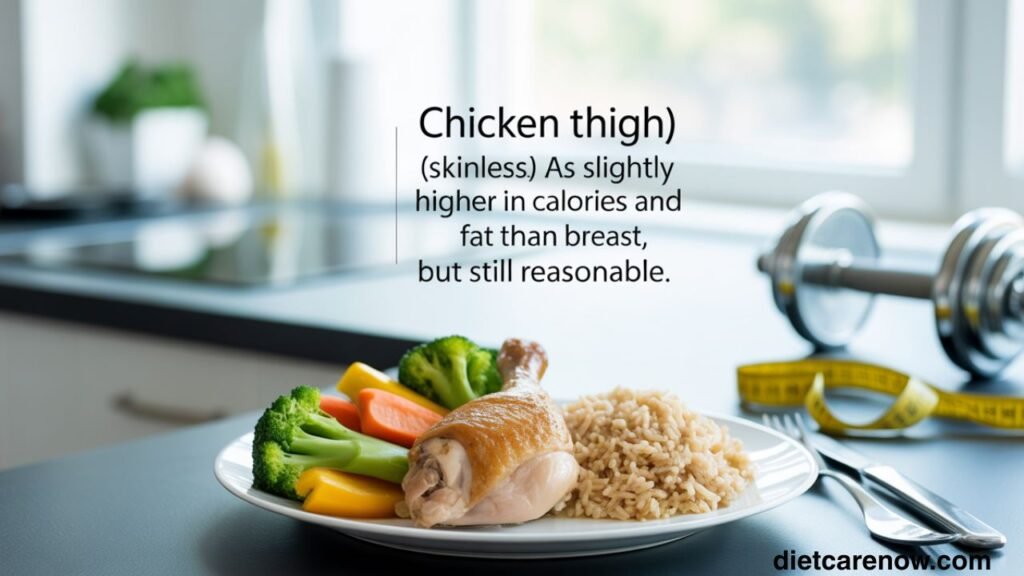
- Chicken thigh (skinless): as above, slightly higher in calories and fat than breast, but still reasonable.
- Chicken drumstick (skinless): slightly lower in calories than thigh per weight unit, but because of the bone and sometimes less meat, the usable meat portion may differ.
- Wings, with skin, tend to be higher in fat and calories due to the skin and sometimes coating.
Chicken Leg in Weight Loss Diets
For those aiming to lose weight, the skinless chicken leg can be a wise choice. Why?
- It delivers solid protein, which helps preserve lean muscle mass during calorie-deficient dieting.
- The moderate fat content gives flavour and satiety, which means you may feel more satisfied and less tempted to overeat.
- It’s easy to portion control (just keep track of how many legs and the size).
- If you remove skin and choose lean cooking methods, you’re controlling the calorie intake while still enjoying a satisfying meal.
Daily protein intake suggestions:
- Many fitness/nutrition guidelines suggest ~1.2–2.0 g of protein per kg of body weight (varies by activity level).
- For example, if you weigh 70 kg and are moderately active, you might aim for ~84–140 g of protein per day. One skinless chicken leg could yield ~25–30 g protein, so it’s a meaningful contribution.
Tips to Reduce Calories When Cooking
Here are practical suggestions to keep the calories in check when cooking skinless chicken legs:
- Marinate wisely: Use herbs, spices, lemon juice, and yoghurt. Skip heavy sugary marinades or sticky glazes that add calories.
- Use an air fryer: Achieves crisp texture with minimal oil.
- Season heavily: Herbs, garlic, chilli, paprika give flavour without adding calories.
- Limit added fats: If you bake, spray a little olive oil or brush lightly instead of drenching in butter or oil.
- Remove visible fat: Even on “skinless” pieces, there may be extra fat; trimming helps.
- Serve with plenty of vegetables: This adds volume and nutrients without huge calories, keeping you full and satisfied.
Conclusion
To wrap up: A skinless chicken leg is a smart, flexible option when you’re keeping an eye on calories, but also want good flavour and solid protein. While it won’t be as lean as chicken breast, removing the skin and choosing gentler cooking methods puts you in a very strong place for healthy eating. Be mindful of portion size, be aware of cooking methods, and pair the meat with vegetables and whole grains for a balanced meal. In the end, healthy eating is not about perfection—it’s about consistent smart choices and enjoying what you eat.