
When you think of a quick bite at McDonald’s, the familiar sandwich that often comes to mind is the McChicken. It’s crispy, convenient, and widely available. But if you’re trying to be mindful of your food choices, it’s worth digging into the nutrition behind it—especially when you order it “plain” (that is, with no mayonnaise and no lettuce), stripped down to bun + chicken patty.
Plain McChicken Nutrition, Understanding fast-food nutrition matters because even small changes—like removing sauce or lettuce—can shift calories, fat, sodium, etc. If you’re trying to maintain a healthy diet, build muscle or lose weight, being clear on what you’re putting in your body helps.
In this article, I’ll break down what a plain McChicken really is, how it differs from the regular McChicken, its calorie breakdown, macros, micronutrients, ingredients, health considerations and practical advice on whether — and how often — it can fit into a balanced diet.
What Is a Plain McChicken?
The McChicken sandwich is a product of McDonald’s: a breaded chicken patty, served in a bun, typically with shredded lettuce and mayonnaise.
When we talk about a plain McChicken, we mean ordering the sandwich without the usual extras: no mayonnaise, no lettuce. In effect, you’re left with the bun and the breaded chicken patty (plus whatever core components remain by default). This removes some of the sauce-calories and possibly the lettuce, which, while small in calories, may change texture and nutrients.
Because most published nutrition values reflect the “standard” version (with mayo and lettuce) it’s important to make adjustments or find references for the no-mayo version.
Also read: /beetroot-and-carrot-soup/
Nutrition Overview (Plain McChicken)
Here’s what we know about the standard version of McChicken:
- In the US, McDonald’s lists the McChicken at 390 calories for the sandwich (bun + chicken + lettuce + mayo).
- Other sources report slightly different values depending on portion size or region: e.g., NutritionValue.org lists 358 kcal for a 131 g serving size.
- For the plain version (no mayo), some databases estimate ≈ 310-331 calories.
Quick nutritional snapshot (plain version ~estimate):
| Nutrient | Value |
|---|---|
| Calories | ~ 310 kcal (single sandwich) |
| Carbohydrates | ~ 40-45 g |
| Protein | ~ 14-15 g |
| Total fat | ~ 12-13 g |
| Saturated fat | ~ 2-3 g |
| Sodium | ~ 700-800 mg |
Calories in a Plain McChicken
The standard McChicken (with mayo) is listed at 390 calories in the US. For the plain version (no mayo), sources suggest roughly 310-331 calories.
Comparison:
- Standard McChicken: ~390 kcal
- Plain McChicken (no mayo): ~310 kcal
- For context: the double-patty version (Double McChicken) is 540 kcal.
So removing the mayo and lettuce knocks off around ~80-90 calories (depending on region and how they calculate). That may be meaningful if you’re tracking calories closely.
Macronutrients Breakdown
Let’s look at each macro for the plain version, based on available data and reasonable estimation.
Carbohydrates
For the no-mayo version, the data: ~43 g carbs per serving. On a standard 2,000 kcal diet, 45 g is ~9% of total daily calories from carbs (assuming 50% of calories from carbs = ~250 g). So it’s modest.
These carbs come primarily from the bun and the breading on the chicken patty.
Protein
The plain version lists ~14-15 g protein. For someone focused on muscle-building (say needing 1.6-2.2 g protein per kg of body weight), this is a modest contribution. It’s useful—but not high-protein by specialist standards.
Total Fat (and Saturated / Trans)
The plain version shows ~12 g of fat, with ~2 g saturated fat. The standard version has higher fat (~17-23 g) in some reports.
Trans-fat is minimal/negligible in the published data (0.1 g in one dataset).
Summary:
- Carbs: ~40-45 g
- Protein: ~14-15 g
- Fat: ~12-13 g (saturated ~2-3 g)
This makes the plain McChicken a moderate-macro food—neither “light” nor “high-protein”.
Micronutrients & Vitamins
What about vitamins and minerals? Here’s a snapshot of what’s present—and what’s missing.
Key nutrients present:
- Iron: ~2-3 mg in some listings (~10-15% DV)
- Calcium: ~120-130 mg (~10-13% DV) in some data.
- Potassium, magnesium, and phosphorus are present but in modest amounts (e.g., potassium ~250 mg)
Which nutrients are low or missing:
- Dietary fibre is very low (~1-2 g), so not much in the way of whole-grain or vegetable fibre contribution.
- Vitamins A, C, and D are virtually negligible in many sources.
- The bun and breading provide the macronutrient bulk; there’s limited vegetable or fruit content.
- Because lettuce is removed in the “plain” version, any micronutrient contribution from that is omitted.
Ingredients in McDonald’s Plain McChicken
Let’s unpack what goes into the sandwich. According to McDonald’s ingredient listing:
Patty ingredients: “Boneless Chicken, Bleached Wheat Flour, Water, Vegetable Oil (Canola Oil, Corn Oil, Soybean Oil, Hydrogenated Soybean Oil), Wheat Flour, Modified Corn Starch, Sea Salt, Spice, Potassium Chloride, Salt, Paprika, Dextrose, Sodium Phosphates, Leavening (Ammonium Bicarbonate, Sodium Acid Pyrophosphate, Baking Soda, Monocalcium Phosphate), Wheat Gluten, Natural Flavors with Extractives of Paprika, Yeast, Corn Starch, Garlic Powder.”
Bun ingredients (typical): Enriched wheat flour (wheat flour, malted barley flour, niacin, iron, thiamine, riboflavin, folic acid), water, sugar, yeast, soybean oil, salt, etc. (common in burger buns). It appears in other sources.
Since we’re talking about the “plain” version, you’re basically using these core components. Removing mayo and lettuce means fewer additions, but the bun and patty remain.
Additives/preservatives of note:
- The oil used in frying is vegetable oil (includes canola, corn, soybean, and hydrogenated soybean) and may include TBHQ and citric acid for preservation in the oil service.
- The breading contains leavening agents and wheat gluten.
- The patty has sodium phosphates (common for moisture retention).
- The bun uses dough conditioners (DATEM, ascorbic acid, mono- and diglycerides) as typical in large-scale bakery production.
Sodium & Cholesterol Content
Sodium
Sodium is a key area of concern in fast food. For the plain version, one dataset lists ~695 mg of sodium for the sandwich (no mayo). That’s roughly 30-35% of the recommended daily limit (which for many adults is ~2,300 mg).
In the standard version with mayo, sodium may be higher (e.g., ~760 mg listed in one source).
High sodium intake is connected with elevated blood pressure and other cardiovascular risks, so the sodium content is a meaningful consideration.
Cholesterol
The plain version lists ~30 mg cholesterol. For many health guidelines, a daily limit might be ~300 mg or more, depending on context, so the sandwich uses ~10% of that. It’s not extreme compared to some foods, but again should be considered in the context of your full day’s meals.
McChicken Patty: How Healthy Is It?
Let’s evaluate the patty and cooking process.
Processing and breading:
The chicken patty is breaded and deep-fried (or cooked in a fryer) by McDonald’s. Breaded and fried items tend to carry more calories (because of the oil), more carbs (due to breading) and more fat than, say, grilled alternatives.
Oil used for frying:
McDonald’s uses vegetable oils (canola, corn, soybean and hydrogenated soybean oil) for frying. The presence of hydrogenated oils and processed vegetable oils means the fat profile is less favourable than “unprocessed” cooking oils. The ingredients list mentions hydrogenated soybean oil.
So while not extremely unhealthy for occasional eating, it is a processed-fried item, which makes it lower in “health quality” compared to grilled whole chicken.
Quality of meat used:
The product is a “boneless chicken” patty, coated and breaded. The ingredients list shows “boneless chicken” but also includes water, modified starches, wheat flour, etc. This means the patty is partly processed. That’s common in fast food, but good to know if you’re comparing to minimally processed chicken breast at home.
Is the Plain McChicken Good for Weight Loss?
If your goal is weight loss, you’re mostly managing calories and nutrition quality. The plain McChicken has a lower calorie count (vs. the full version) and removes mayo/lettuce extras, which is a smart step.
- Portion size benefit:
At ~310–330 calories, the plain McChicken is not “light,” but it can fit into a daily calorie budget if you’re mindful. It’s simpler than the full sandwich and lighter than many larger burgers or combo meals. - Calorie control:
By choosing the plain version, you’ve removed some calories (from mayo and perhaps lettuce). That’s a positive for weight control. If you pair it with fewer fries, a water or low-cal drink, and skip high-cal sauces, it can be reasonable. - When it could fit vs. when to avoid:
- Fit: If you know your daily calorie target and the remainder of your meals are nutrient-dense (fruit, vegetables, lean protein, whole grains), then eating a plain McChicken occasionally is fine.
- Avoid or limit: If you’re eating it alongside a large fries, sugary drink, or other high-calorie items, you’ll blow your budget. Also, if your diet is already high in processed/fried foods, high in sodium or low in vegetables.
High-Protein Fast-Food Option?
Is the plain McChicken a “high-protein” choice? Let’s examine.
The plain version gives ~14-15 g of protein in a sandwich. That’s modest. For many adults (especially those training or building muscle) target protein might be 100 g+ per day. So this sandwich contributes, but is not “high-protein” in the sense of delivering a large protein punch.
If you’re looking for a fast-food chicken option with better protein, you might look for grilled chicken sandwiches (with 20-30 g+ protein) or choose items where the meat is the main component and breading/oil is minimised. At McDonald’s, other menu items may offer more protein (e.g., grilled chicken wrap or larger chicken sandwiches,) though availability varies by region.
Diet-Friendly Alternatives at McDonald’s
If you’re at McDonald’s and want smarter fast-food options (either instead of or customising the plain McChicken), here are ideas:
- McDouble plain – Remove the cheese or sauce to reduce calories and fat.
- Grilled chicken wrap (if available in your region) – This may offer less breading/frying and more lean protein.
- Side salad or apple slices – Instead of large fries, choose a side salad (without heavy dressing) or apple slices to keep calories lower.
- Water or unsweetened drink – Avoid sugary soda to save calories.
- Choose plain version – As you’re reading, plain (no mayo) is better calorie/fat-wise.
Customisation Tips to Make It Healthier
If you like the taste of McChicken but want to improve its nutrition profile, try these tips:
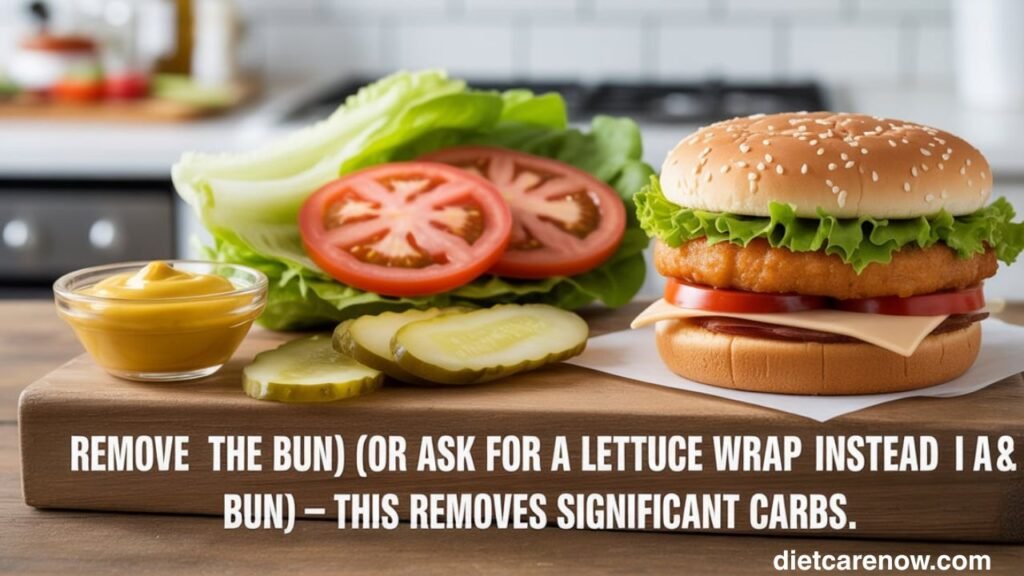
- Remove the bun (or ask for a lettuce wrap instead of a bun) – This removes significant carbs.
- Add lettuce, tomato or extra veggies if the restaurant allows – This increases fibre and micronutrients with minimal calories.
- Skip or ask for light mayonnaise or a lighter sauce – It can cut fat and calories.
- Ask for no cheese / skip optional extras – Many fast-food items come with extras that add calories.
- Pair the sandwich with water, side salad or apple slices instead of fries – This changes the overall meal balance.
How Often Can You Eat a Plain McChicken?
Frequency depends on your overall diet, calorie needs and health goals.
If your diet consists mostly of whole, minimally processed foods (vegetables, fruits, lean meats, whole grains), then an occasional plain McChicken (perhaps once every week or two) is likely fine.
Suppose your diet already has many fast-food or processed items. In that case, you may want to limit it to less often (every few weeks), because the accumulation of sodium, processed fat, and lower nutrient quality can add up.
Tips for mindful fast-food eating:
- Plan: know how many calories you have left for the day.
- Choose the plain version, skip large sides or sugary drinks.
- Balance the rest of the day with protein, fibre, and vegetables.
- Be aware of sodium intake and ensure you drink water and include potassium-rich foods (fruit, vegetables) in other meals.
Final Thoughts
In summary: ordering the plain McChicken (bun + chicken patty, no mayo/lettuce) is a smarter version of a fast-food chicken sandwich—lower in calories, fat and sauce. It gives you modest protein (~14-15 g), ~40-45 g carbs, ~12-13 g fat and around ~300-330 calories (depending on region) if you skip mayo.
However, it remains a processed, breaded and fried item with modest micronutrients, relatively high sodium and limited fibre or veggie content. So while it can fit into a balanced diet (especially if you plan around it), it’s not equivalent to a freshly grilled chicken breast with brown rice and vegetables in terms of nutrient quality.
Encouragement: Be informed. If you choose a plain McChicken, you’re making a better choice than many alternatives. Pair it with healthier sides, ensure your other meals are high quality, and don’t rely on such sandwiches as staples every day. Moderation + planning = better outcomes.
Next time you walk into McDonald’s, you can feel confident about what you’re eating—and how it fits into your day.