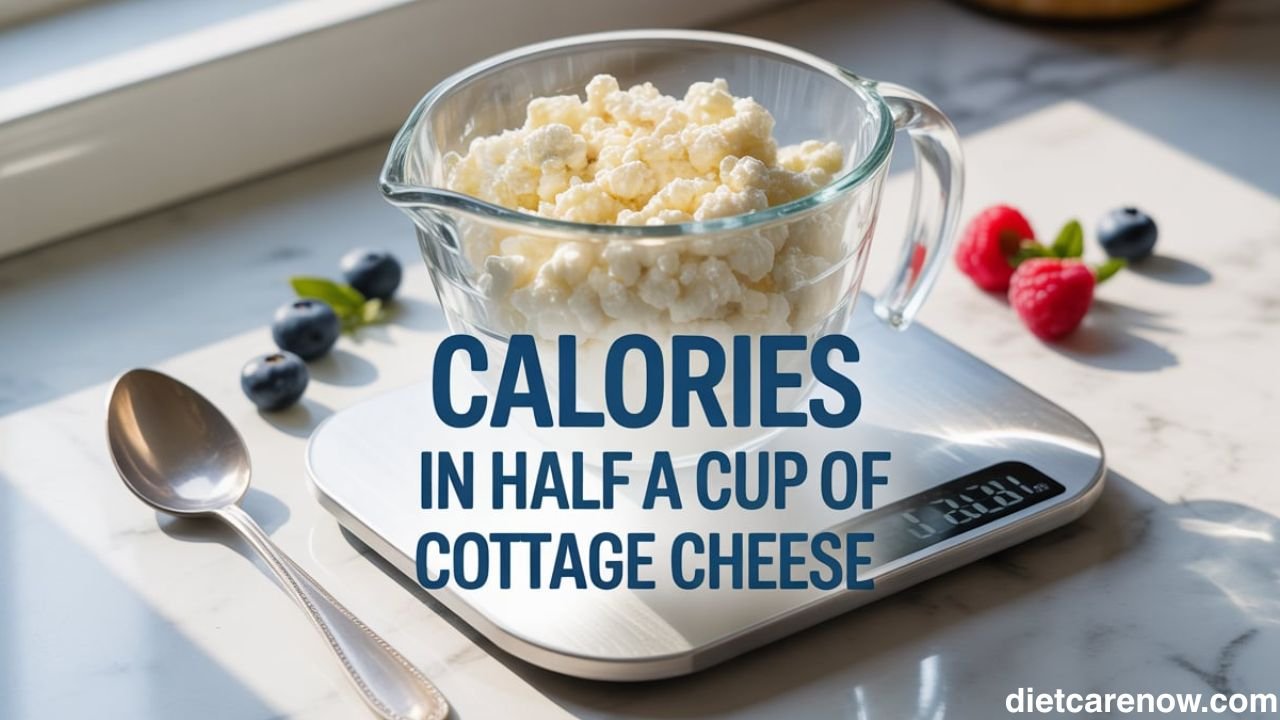
If you’ve glanced at your grocery store diet-friendly shelves lately, you may have noticed a little tub of cottage cheese staring back at you more often. Once relegated to old-school dieting days, it’s now making a strong comeback—especially among folks focused on health, muscle, or weight loss goals. Its rise in popularity comes from a few practical advantages: it’s easy to prepare, highly versatile (sweet or savoury), and offers a quality balance of protein and other nutrients. Calories in half a cup of cottage cheese
As more people realise that food doesn’t have to be complicated to be nutritious, cottage cheese fits into that sweet spot: simple, real-food dairy with tangible benefits. At the same time, it helps to quickly check what it brings nutritionally—so you know why people are choosing it.
Why Cottage Cheese Is Trending in Healthy Diets
The renewed interest in cottage cheese is driven by several factors:
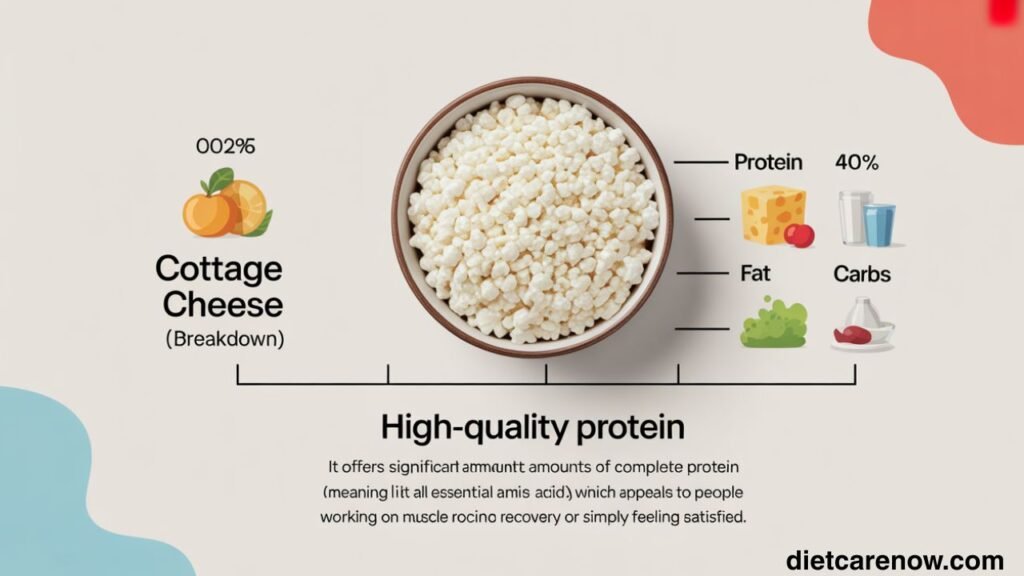
- High-quality protein: It offers significant amounts of complete protein (meaning it contains all essential amino acids), which appeals to people working on muscle recovery or simply feeling satisfied.
- Relatively modest calories: Compared with some richer dairy foods, you get a decent serving without a huge calorie load—helpful for weight management.
- Versatility: You can eat it plain, mix it with fruit or veggies, use it in dips, smoothies, or even desserts. That flexibility helps it stay relevant in modern eating.
- Micronutrient profile: Besides protein and dairy-based nutrients, cottage cheese brings in elements like calcium, B-vitamins, selenium—not always the first nutrients people think of, but they count. For example, one source lists that a half-cup of 1% milk-fat cottage cheese provides 14 g protein, 3 g carbs and 1 g fat.
- Diet-friendly credentials: For those tracking macros, the fat content can be low and the carb content modest, making it easier to fit into structured meal plans.
Also read: /low-sodium-tofu/
Quick Overview of Its Nutritional Value
Before diving into the details for half a cup, here’s a summary of what you’re generally getting:
- A strong protein hit (typically 12-15 g in many half‐cup servings). Multiple sources support this.
- Low to moderate carbs (generally only a few grams) because the sugar comes mainly from lactose.
- Variable fat content depending on whether it’s non-fat, low-fat or full-fat.
- Additional minerals and vitamins like calcium, selenium, phosphorus, vitamin B12 and more.
- Some caveats: sodium may be higher (depending on brand/flavour) and some varieties add sugar or flavourings—so label reading matters.
How Many Calories Are in Half a Cup of Cottage Cheese?
Let’s get specific. Because cottage cheese comes in several fat levels (and sometimes with added flavourings), the calorie content for a half-cup will vary. Below are typical values and comparisons.
Exact calorie count for popular types
- For a full-fat (4 % milk-fat) plain cottage cheese, one data source gives about 116 calories for a ½-cup serving.
- For a low-fat (2 % milk-fat) version: one listing shows 102 calories in a ½-cup.
- Others list even lower for leaner versions: for example, some 1% milk-fat or very low‐fat versions list around 81-90 calories for ½-cup.
Fat-free vs low-fat vs full-fat comparison
Here’s how fat content influences calorie count:
- Fat-free (0 % milk fat): Since fat contributes 9 calories per gram, zeroing out fat reduces the calorie load. Some manufacturers list very low calories (though they may add stabilisers or other ingredients).
- Low-fat (1 % to 2 % milk fat): A balance—most of the fat removed, moderate calorie savings. Example: ~102 calories for ½-cup at 2 % milk fat.
- Full-fat (4 % milk fat): More creamy texture, richer mouth-feel, slightly higher calories. Example: ~110-120 calories for ½-cup.
- Cream-style or added cream/fruit/flavour versions: These may carry higher calories due to added fat or sugars—not always listed as plain cottage cheese. They’re worth treating separately.
Calorie Comparison Chart: Types of Cottage Cheese
Here’s an easy-to-read table summarising common types, their calories, and basic macronutrient breakdowns for a ½-cup serving. Note that exact values will vary by brand and whether it’s small-curd or large-curd, whether fruit/flavour is added.
| Type of cottage cheese | Fat % | Calories (½-cup)* | Approx Protein | Approx Carbs | Approx Fat |
|---|---|---|---|---|---|
| Non-fat / very low-fat (0 %) | 0 % | ~ 80-90 cal | ~12-14 g | ~3-5 g | ~0-1 g |
| Low-fat (1–2 % milk‐fat) | 1–2 % | ~ 90-102 cal | ~13-15 g | ~4–6 g | ~2–3 g |
| Full-fat (4 % milk‐fat) | ~4 % | ~ 110-120+ cal | ~12–14 g | ~4–6 g | ~4-5+ g |
| Flavoured/cream-style (added fat/sugar) | — | can be higher | variable | higher | higher |
Different Fat Percentages and Their Calorie Impact
Let’s look in more detail at how fat percentages shift the numbers, and what that means for your diet.
0 % fat cottage cheese
When the milk fat is removed (or very nearly so), the calorie load drops. One source lists 81 calories for a ½-cup of 1% milk-fat cottage cheese (which is near the very low-fat end) with 14 g protein, 3 g carbs and 1 g fat.
Benefits: minimal fat, lower calories, high protein—good for calorie-restricted plans.
Considerations: texture may be less creamy, fat helps flavour and absorption of fat-soluble vitamins, so the “feel” may be less rich.
1 %-2 % (low-fat) cottage cheese
This is a popular middle ground. For example: ½-cup at 2% milk-fat shows 102 calories, 15.5 g protein, 4.1 g carbs, 2.18 g fat in one listing.
Another listing: ½-cup (113 g) of 2% small curd: 90 calories, 2.5 g fat, 12 g protein.
Benefits: still quite lean, but more “dairy flavour” and creaminess than ultra low-fat. Good compromise.
4 % full-fat cottage cheese
At this level, you’re getting richer texture and a slightly higher calorie and fat load. Example: ½-cup (113 g) full-fat small curd, 110 calories, 5 g fat, 12 g protein.
Another data point: one source lists ~116 calories for half-cup full-fat plain cottage cheese.
Benefits: delicious mouth-feel, possibly more satisfying for some palates, may help with satiety in certain dietary contexts.
Considerations: slightly higher calorie load—but still modest compared to many snack or dessert options.
Cream-style / added cream/flavour
Some cottage cheeses are marketed as cream-style, or have added fruit, sugar or flavouring. These versions can significantly increase calories (and sugar). For weight- or calorie-conscious eating, these should be treated like a separate category, and the nutrition label must be checked carefully.
Protein Content in Half a Cup of Cottage Cheese
One of cottage cheese’s biggest selling points is the protein content—and for good reason. Whether you’re trying to maintain muscle, lose weight or just build a more nutrient-dense plate, protein matters.
Why it’s popular among athletes & weight-loss enthusiasts
- Protein helps preserve lean muscle mass. When calorie intake is reduced (as in dieting), muscle loss is a risk—so eating sufficient protein helps.
- It promotes satiety: a higher-protein food takes longer to digest (especially if it’s casein protein, as in dairy like cottage cheese) and can help reduce overall calorie intake by reducing hunger.
- For those working out, recovery and muscle repair benefit from complete proteins (which cottage cheese offers).
- For weight-loss plans, high-protein, moderate-calorie foods are gold. Cottage cheese fits that profile nicely.
Amino acid benefits
Cottage cheese is rich in casein protein (the slower-digesting milk protein) and contains all essential amino acids. The slow release of amino acids means it can support muscle repair over a longer period (for example, overnight) compared to some faster-digesting proteins. This is one reason why cottage cheese is sometimes recommended as a “bedtime snack” for active people.
Carbs and Sugar in Half a Cup of Cottage Cheese
Although often thought of only in terms of protein and fat, we also need to check the carbohydrate and sugar side to get a full picture.
Natural sugar vs added sugar
- The primary sugar in plain cottage cheese is lactose (the natural milk sugar). For most plain versions, added sugars are minimal or none. For example, a low‐fat cottage cheese version listed 0.37 g of sugar in a ½-cup.
- However, if cottage cheese comes in fruit-added, flavour-added or sweetened versions, the sugar (and thus carbohydrate and calorie) load rises—so always check the label.
Lactose considerations
- People with lactose intolerance may find cottage cheese easier to tolerate compared to some other dairy foods, but it still contains lactose. Some brands offer lactose-free cottage cheese or varieties where a lactase enzyme has been added.
- If you’re sensitive to lactose, choosing a low-lactose or lactose-free version, or limiting the portion, is wise.
Carbohydrate totals
In many plain half-cup servings, carbs tend to be low: e.g., ~3–6 g. Example: ½-cup low-fat (1 %) cottage cheese: ~3 g carbs.
Thus, cottage cheese may fit well into lower-carb or moderate-carb eating plans.
Nutrient Profile Beyond Calories
While calories, protein, fat, and carbs are key, cottage cheese brings other nutrients that contribute to health beyond just the macronutrients.
Calcium, Vitamin B12, Selenium, Probiotics
- It’s a good source of calcium: dairy is one of the more reliable ways to get calcium in diets, with cottage cheese offering a meaningful amount. For example, one version gives around 6 % of the DV for calcium in a half-cup.
- Vitamin B12: Important for nerve and blood health. One half-cup of low-fat cottage cheese lists B12 at 29 % of DV.
- Selenium: A powerful antioxidant mineral. The same half-cup listing showed selenium at about 18.5 % of DV.
- Phosphorus, potassium, riboflavin: Also present in decent amounts.
- Probiotics: While not every brand emphasises probiotics, cottage cheese is a cultured dairy product (meaning bacterial cultures were involved), so in some versions there may be beneficial cultures present—though this varies by brand and whether the product is explicitly probiotic-fortified.
- Low-carb / keto-friendly potential: Given the low carbohydrate content in plain cottage cheese, it can be an option for lower-carb diets—so long as you choose unsweetened/plain versions and monitor fat/sodium accordingly.
Cottage Cheese vs Other Dairy Snacks
To help place cottage cheese in context, how does it compare with other common dairy snack choices like Greek yoghurt, ricotta cheese, cream cheese or a simple serving of milk?
- Greek yoghurt: Generally high in protein, often slightly higher carbs (depending on flavour), and can be higher cost. If plain and unsweetened, it’s a strong competitor.
- Ricotta cheese: Typically higher in fat and calories per same volume than low-fat cottage cheese, so for calorie-controlled eating, cottage cheese may edge it out.
- Cream cheese: Much higher in fat and calories, and lower in protein relative to volume. For example, ½-cup cream cheese might carry many more calories.
- Milk: A good nutrient base, but lower in protein per calorie compared with cottage cheese. For example, you’d need more volume to reach the same protein.
Is Cottage Cheese Good for Weight Loss?
Short answer: yes, it can be an excellent tool—when used wisely.
Satiety factor
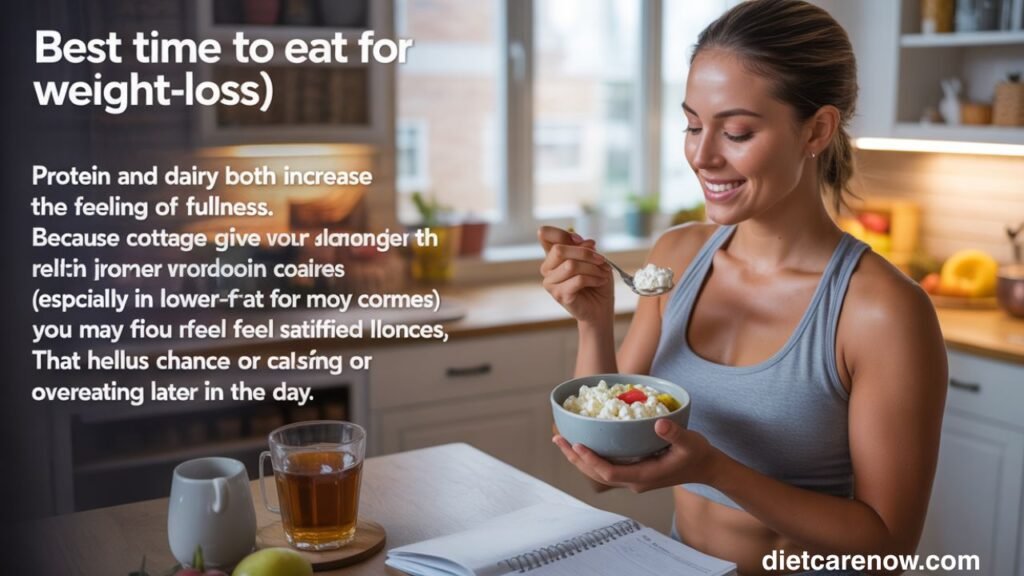
Protein and dairy both help increase the feeling of fullness. Because cottage cheese gives you significant protein relative to calories (especially in lower-fat forms), you may feel satisfied longer for fewer calories. That helps reduce the chance of snack raids or overeating later in the day.
Low-calorie & high-protein benefits
As discussed, a half-cup of low-fat cottage cheese could be around 90-100 calories with 12-15 g protein. That’s a strong “protein-per-calorie” ratio, which is ideal when your goal is to hold onto muscle and maximise fullness while in a calorie deficit.
Portion control tips
- Measure out half a cup rather than eyeballing. It’s easy to pour more than intended.
- Choose plain, unsweetened versions to avoid hidden sugars or flavour additives.
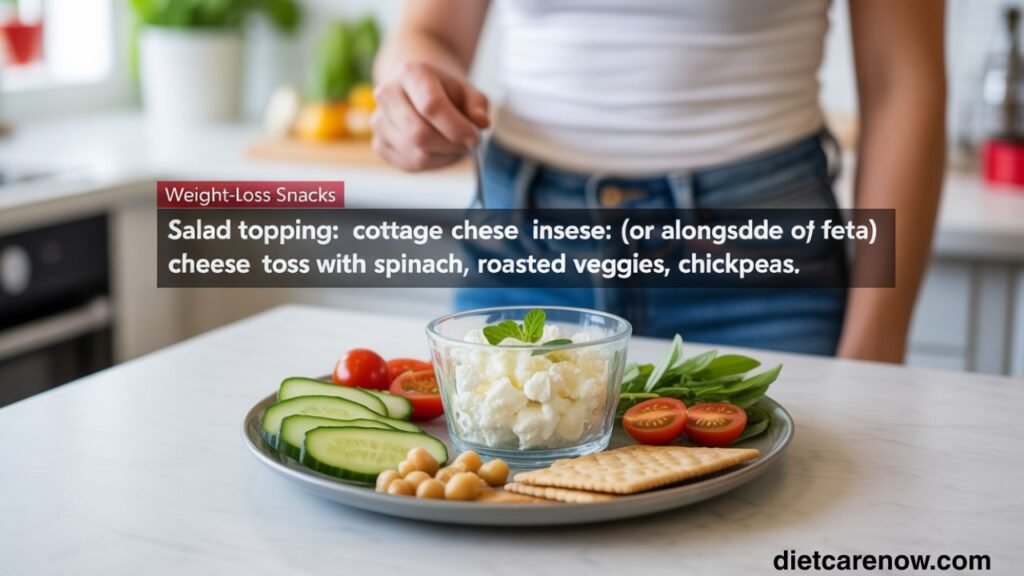
- Pair with volume-adding foods: berries, cucumber slices, cherry tomatoes, or whole-grain crackers. This increases meal size without blowing calories.
- Use it as a snack or mini-meal, especially if you find yourself hungry between main meals.
- Check sodium: since some cottage cheeses can be high in sodium, if you have blood-pressure concerns or are watching salt, pick a low-sodium brand.
Is Cottage Cheese Good for Muscle Gain?
Yes—especially thanks to the protein profile and slower-digesting casein content.
Casein protein benefits
- Casein is a slower-digesting protein compared with whey; it provides a more sustained release of amino acids into the bloodstream. That makes it useful for thickening the “amino acid availability” window.
- For athletes or strength-trained individuals, that means cottage cheese can help with overnight muscle repair or recovery after workouts.
Best time to eat cottage cheese for muscle building
- Post-workout snack: Within an hour after a strength session, combining cottage cheese with a little fruit or whole grain can provide protein and some carbs for recovery.
- Pre-bed snack: Some people enjoy a ½-cup of cottage cheese before bed because the slow-digesting protein supports overnight muscle repair and prevents catabolism.
- As part of a balanced meal: Combine with vegetables and complex carbs for lunch or dinner to get protein, fibre and volume.
How to Measure Half a Cup Correctly
Since much of our discussion hinges on “½ cup”, it’s useful to get practical about how to measure accurately.
Serving size tips
- Scoop the cottage cheese gently—don’t pack it aggressively (unless otherwise instructed). Many nutrition labels assume a “not packed” measurement. For example, one listing says “½ cup, not packed” for 116 calories.
- If you don’t have measuring tools, ½ cup is roughly 8 tablespoons.
- If using a kitchen scale, many listings cite ½ cup = ~113 g (for some brands) or ~125 g for others. Use the brand’s label for accuracy. For example, one source lists ½ cup = 113 g for a 90-calorie listing.
Kitchen measurement tricks
- If you’re mixing into a bowl, measure into a small, lightweight bowl and level off the top for accuracy.
- If you’re on the go, some brands provide single-serve portions (½ cup pre-packaged), which removes measuring guesswork.
- Use consistent measurement to track calories properly—especially if you’re tracking intake for a diet plan.
Full-Fat vs Low-Fat Cottage Cheese: Which Should You Choose?
This depends on your goals, taste preferences, and how cottage cheese fits into your overall diet.
When to choose low-fat for dieting
- If your primary aim is weight loss, and you’re aiming to reduce overall calorie intake, then low-fat (1–2 %) or even non-fat versions give you more “protein per calorie”.
- If you’re tracking macros and want to keep fat lower, the lean versions offer better flexibility.
- If you’ll be eating cottage cheese frequently, the cumulative difference in calories and fat can matter.
When full-fat is better for balanced nutrition
- If you don’t have strict calorie restriction, the fuller-fat version can provide richer texture and help you feel more satisfied—sometimes helping control appetite later.
- If your diet allows moderate fat intake and you are including cottage cheese as part of a broader nutrient-dense meal, the extra fat may not be an issue.
- If you are eating fewer overall meals or eating less often (intermittent fasting or fewer meals per day) and want a more satisfying snack, the full-fat version may make more sense.
Healthy Cottage Cheese Meal Ideas
Let’s turn the theory into real food. Here are some practical ways to include cottage cheese in your day:
Breakfast bowls
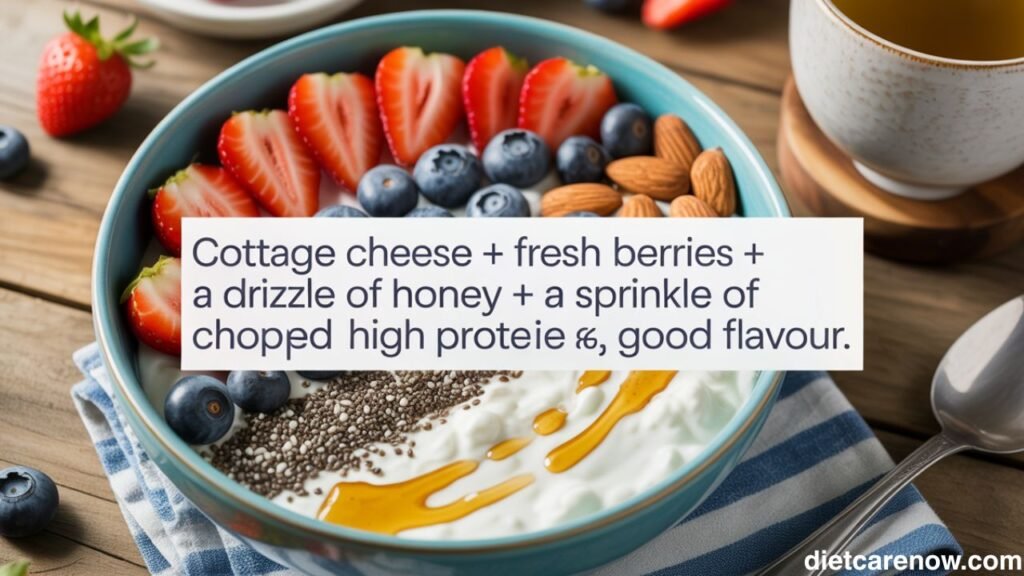
- Cottage cheese + fresh berries + a drizzle of honey + a sprinkle of chopped nuts = high protein, good flavour.
- Cottage cheese + sliced banana + cinnamon + whole grain toast on the side.
- Savoury version: cottage cheese + chopped cherry tomatoes + cucumber + whole-grain pita or toast.
Salads, smoothies, snacks
- Salad topping: cottage cheese instead of (or alongside) feta/cheese– toss with spinach, roasted veggies, chickpeas.
- Smoothie booster: blend ½-cup cottage cheese + frozen berries + small banana + splash milk or plant-milk — yields a creamy high-protein smoothie.
- Snack idea: ½-cup cottage cheese + pineapple chunks (or chopped apple) + flaxseeds.
- Use as dip: mix cottage cheese with herbs (dill, garlic, chives) and serve with raw veggie sticks.
Dessert options
- Cottage cheese “cheesecake” bowl: ½-cup cottage cheese + cocoa powder + stevia/sweetener + raspberries on top.
- Overnight oats twist: layer oats + milk + cottage cheese + fruit; refrigerate overnight for a creamy, high‐protein breakfast.
- Cottage cheese pancakes: mix cottage cheese + eggs + oats/pancake mix for protein-rich pancakes.
Who Should Avoid or Limit Cottage Cheese?
While cottage cheese is beneficial for many, it’s not perfect for everyone. Here are some considerations.
Lactose intolerance
- Despite being somewhat lower in lactose than some other dairy products (depending on brand), cottage cheese still contains lactose. If you’re lactose intolerant, symptoms may occur.
- Options: choose brands labelled “lactose-free cottage cheese” or small curd versions processed differently, or limit portion size and monitor tolerance.
High-sodium concerns
- Some cottage cheeses are higher in sodium than you might expect (sodium helps preserve the product and influences flavour). If you have high blood pressure or are on a sodium-restricted diet, check the label. One source flagged that sodium may be 20% of the DV in some versions.
- Tip: Choose “low-sodium” or “reduced-sodium” versions, rinse the curds lightly if you want, or offset sodium elsewhere in your diet.
Flavoured/added-sugar versions
- Some cottage cheeses come with added fruit, sugar or flavourings which can significantly increase calories and sugar. If you’re using it for weight loss or carb control, plain is safer.
- Always check the label: “added sugar”, “fruit in syrup”, juices, etc, can change the game.
Conclusion
Let’s bring it all together.
- A half-cup of plain cottage cheese typically contains somewhere around 80-120 calories, depending on fat content.
- You’re getting a strong protein hit in that portion—often 12-15 g or more—which makes it a smart move for muscle support, satiety and general nutrition.
- The fat content (0 % / 1–2 % / 4 %) significantly affects calories and perhaps texture and satisfaction; choose the version that fits your goals.
- Beyond calories and macros, cottage cheese brings meaningful micronutrients: calcium, vitamin B12, selenium, phosphorus, etc.
- It stacks up favourably against many other dairy snacks if your goals are weight control or muscle gain.
- Practical measurement matters (½ cup = ~113-125 g depending on brand) and plain, unsweetened versions give you the purest benefit.
- With smart pairing and preparation (breakfast bowls, salads, snacks, desserts), cottage cheese can become an everyday tool—not just a “diet food”.
- One caveat: for people with lactose issues, high-sodium concerns, or who choose sweetened/ flavour-added versions, some caution is needed.
- If your goal is to include high-quality protein in a balanced diet while keeping an eye on calories, cottage cheese is absolutely worth considering.